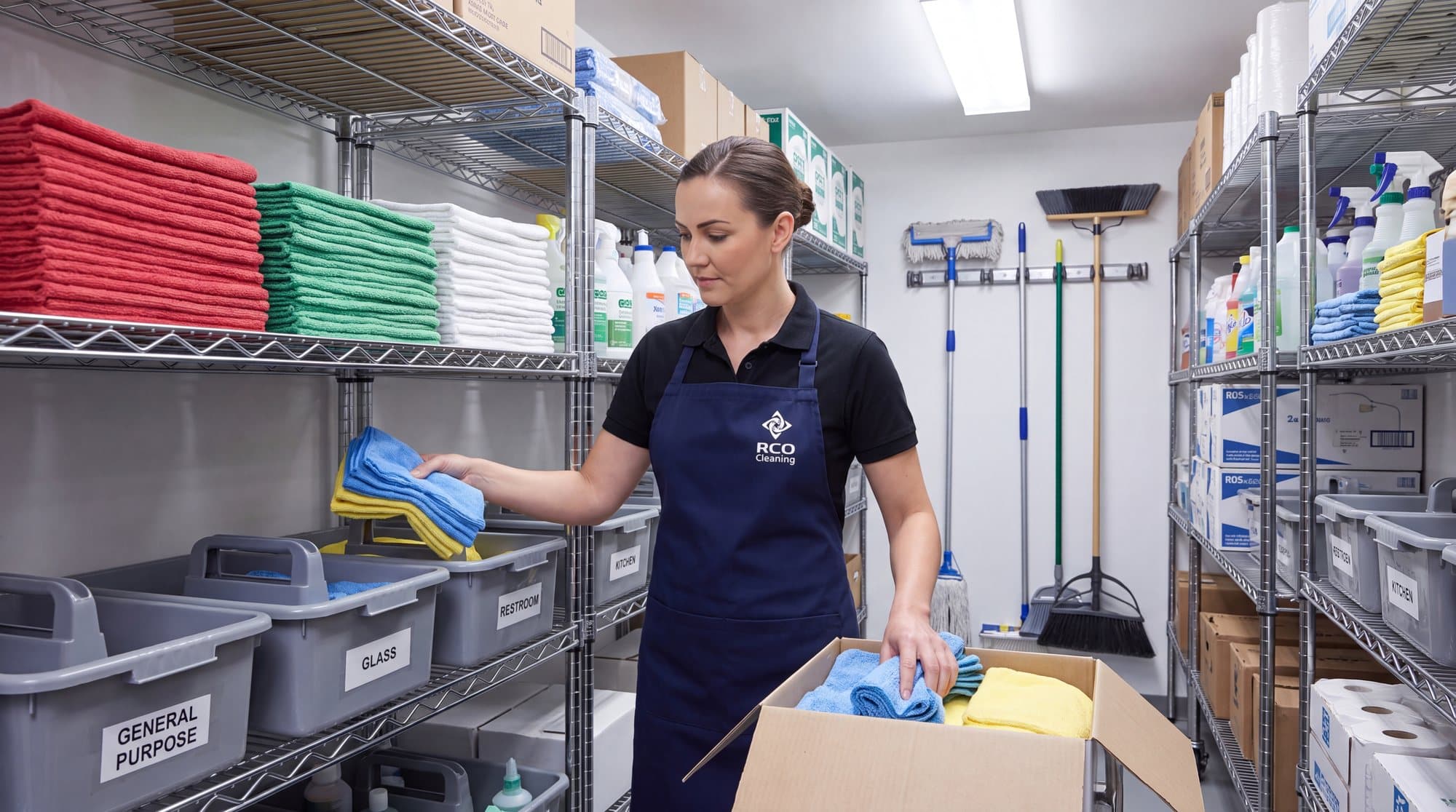

In short: A cleaning contract should specify in writing who provides each supply. Commercial cleaning companies typically supply their own chemicals, tools and equipment. Paper towels, toilet paper, hand soap and trash liners are provided by either party and the contract will specify who provides them. Whoever brings chemicals into your facility should also supply their safety data sheets as required by OSHA. RCO Cleaning will put supplies in writing during a free walkthrough. Call (248) 849-0000.
Who supplies what: the four kinds of commercial cleaning supplies
| Category | Examples | Usually supplied by |
|---|---|---|
| Chemicals | General-purpose, glass and restroom cleaners, disinfectant, floor finish | The cleaning company |
| Tools and equipment | Microfiber, mops, vacuums, floor machines, extractors | The cleaning company |
| Consumables | Paper towels, toilet paper, hand soap, trash liners, seat covers | Either one: agree it in writing |
| Dispensers | Towel, soap and tissue dispensers | Often the building, matched to the paper and soap it buys |
Things get murky with consumables. If the facility purchases them, determine who will place the orders, where they'll be kept and how the cleaning crew will communicate that they are running out. If the cleaner supplies them, agree on which products will be used and how they will be charged. Regardless, the contract should outline who will replenish the restrooms and break areas, as well as how frequently.
Dispensers should get their own line item here. Some towel, tissue and soap dispensers only accept proprietary refills. If your building changes paper vendors, you might find yourself with a closet full of rolls that don't fit your dispensers. Whenever possible, compare a product to the dispenser on the wall before making a switch.
Refills and restocking are part of the rules too. OSHA's sanitation standard mandates that each lavatory be supplied with hand soap (or similar cleaning agent), running water, and individual hand towels or air blowers. If there is an empty soap dispenser at 2 p.m., that is a scope issue before it is anything else.
What should your cleaning contract say about supplies?
What does OSHA expect for safety data sheets?
OSHA's hazard communication standard is based on the Globally Harmonized System of Classification and Labeling of Chemicals (GHS). Manufacturers and importers of chemicals are required to label containers with a signal word, pictogram and hazard statement for each hazard, as well as precautionary statements. Manufacturers and importers must also provide safety data sheets (SDS) in a specific 16-section format. Employers are required to maintain safety data sheets for each hazardous chemical they have in their workplace and make them accessible to employees during each work shift. Having the SDS available electronically is acceptable as long as there is no impediment to immediate access.
Two sections of the rule apply when you hire a cleaner. Each covered employer must have a written hazard communication program and list of hazardous chemicals on site. Also, at multi-employer worksites, if one employer has chemicals that could expose another employer's employees, they must ensure those employers have on-site access to the safety data sheets and understand any precautions. Your nighttime office cleaning crew is a typical example, so request a list of products and the SDS at the beginning.
Michigan operates its own program, MIOSHA, which adopted the federal hazard communication standard by reference. Michigan's Right to Know Law includes additional responsibilities such as posting of where safety data sheets are maintained, posting notice of a new or revised safety data sheet no later than five working days after it is received, and employees' right to request the sheets.
You might ask: do everyday products get exempted? The standard exempts consumer products used at work the way a consumer would use them, as long as employees aren't exposed more often or for longer than a consumer would be. If you're using a product for hours every night like a crew is, it probably does not apply. That's just another reason for professional cleaners to keep those sheets handy.
How to read a safety data sheet in two minutes
Sixteen sections sounds like a lot, but the OSHA rule standardizes the headings and order so each sheet is uniform. You don't need to be a chemist. These are the sections you'll be using as a building or office manager.
| Section | Heading | Why you'd read it |
|---|---|---|
| 1 | Identification | Verifies that the sheet is for the product in the closet, and provides contact information for the manufacturer. |
| 2 | Hazard(s) identification | Signal word, pictograms and hazard statements: the nutshell version of what can happen. |
| 4 | First-aid measures | First aid instructions. This includes: what to do if the product gets on skin, in eyes, or if swallowed or inhaled. |
| 7 | Handling and storage | Storage instructions. How to store the product, and what it must be stored away from. |
| 8 | Exposure controls/personal protection | Whether gloves, eye protection or ventilation are needed |
| 16 | Other information | It has the date the sheet was created or last updated, so you know it's up-to-date. |
Place the sheets where they are accessible to employees during each shift such as in a binder in the janitor's closet or a link that everyone has access to open. When a product is updated, so is the sheet. In Michigan this is when the five working day posting requirement would go into effect.
The right product for the surface
Match product to surface
Abrasives scrape; the wrong glass cleaner streaks; acids may etch stone. Read the manufacturer's instructions. Always test in an inconspicuous place.
Disinfectant where it belongs
EPA-registered, applied to surfaces the label says it can be used on, and allowed to remain wet for the full contact time.
Labels you can verify
Safer Choice, Design for the Environment and Green Seal certify products with assessed ingredients. Learn more about each mark in our green cleaning guide.
Concentrates, measured
Mixed through a dispenser according to the ratio on the label, not eyeballed into the closest bottle.
Every bottle labeled
An unlabeled spray bottle is a puzzle no one should have to decipher at 11 p.m.
Stored safely
Containers are sealed and products secured, according to the EPA's six steps for using disinfectants.
Supply habits to drop
- Mixing two products in one bucket to make it stronger
- Topping up a labeled bottle with a different product
- Buying the cheapest roll of towels that doesn't fit the dispenser
- Storing chemicals next to the break room coffee
- Throwing away the safety data sheets because "it's just soap"
Commercial cleaning supplies questions
Does the cleaning company have to give us safety data sheets?
OSHA's rule mandates that chemical manufacturers make them available and employers maintain availability to their employees. And where contractor-supplied chemicals could expose your employees, OSHA's rule requires on-site availability of the sheets as well. Request them upfront.
Who should buy the paper towels?
Either is fine. The point is that the contract specifies who purchases them, what products, and who restocks.
Do we have to use green products?
No, but many facilities request them. Safer Choice and Green Seal labels help you easily identify them.
Who do I ask for the safety data sheets in our building?
Ask your supplier of chemicals, typically your cleaning contractor. Where those chemicals may expose your employees, OSHA expects on-site access to the sheets. RCO Cleaning will provide you with a product list and safety data sheets for your facility anytime: (248) 849-0000.
How RCO Cleaning handles supplies in your building
At RCO, supplies are settled at the free walkthrough, and everything is written down. Supplies we supply, supplies you want us to supply, supplies kept in the building's stockroom. Our teams bring professional grade products and equipment for janitorial services, all of our employees are trained on them, and upon request we can provide you with a list of products used in your building along with their safety data sheets.
Sources

Next guide
How often an office should be cleaned depends on its traffic, but most offices work well with cleaning five nights per week. Choose your building and traffic pattern, and RCO Cleaning's planner shows a schedule that will work.